
Cost Pressure Has Reached the Distribution Channel
As of June 11, 2026, rising base oil prices, higher lubricant additive costs and tighter supply conditions continue to affect the global lubricant industry. For lubricant importers and distributors, the main concern is no longer simply whether finished-product prices will rise. The more important question is whether current selling prices can cover the cost of replacing inventory in the next purchasing cycle.
This creates a difficult situation:
- Replenishment costs are rising
- Customers remain price-sensitive
- Inventory requires more working capital
- Selling prices cannot always be adjusted immediately
- Distributor margins are becoming increasingly compressed
The purpose of this market update is not to encourage panic buying. It is to help importers and distributors understand the current cost structure, protect cash flow and make more informed purchasing decisions.

1 June 11 Market Snapshot: What the Latest Data Shows
The current pricing cycle is moving faster and reaching more product categories than a conventional raw-material adjustment. Industry analysis covering the period through late May recorded:
Market Indicator |
Latest Industry Data |
Meaning for Distributors |
|---|---|---|
Lubricant price actions
|
37
|
More suppliers are passing through costs
|
Companies announcing adjustments
|
19
| |
Price-increase rounds
|
3 in 91 days
|
Less time to react between adjustments
|
Average midpoint increase
|
Approximately 22%
|
Replacement costs may rise rapidly
|
Maximum synthetic increase
|
35%
|
Full synthetic products face greater pressure
|
Average notice period
|
14.6 days
|
Buyers have less planning time
|
Asian base oil markets experienced a sharp escalation during the spring pricing cycle, becoming one of the most visible signals of the base oil price increase 2026. According to the Asian base oil price report for early February, Group II 150N was assessed at approximately USD 720–760 per metric ton on an FOB Asia basis. By mid-April, the same grade had risen to around USD 1,710–1,750 per metric ton, according to a later Asian Group II base oil market assessment.
This sharp movement forms part of the wider pressure on the global lubricant supply chain. At the same time, the Group III base oil shortage has increased uncertainty for manufacturers producing full-synthetic and low-viscosity engine oils. Actual purchasing prices still vary by viscosity, origin, contract terms, delivery basis and shipment date, but the trend is forcing lubricant importers to review replacement costs more frequently.
Industry participants have also reported a lubricant additive cost increase of approximately USD 400–500 per metric ton. JobbersWorld’s lubricant input cost analysis noted that higher petrochemical feedstock and energy costs were accompanied by longer lead times and rising transportation expenses. Higher fuel surcharges, plastic resin prices and steel costs have also increased the cost of bottles, pails, drums and international delivery.
These pressures continue to pass through to finished products. According to the finished-lubricant price adjustment tracker, HF Sinclair Lubricants & Specialties and Petro-Canada Lubricants scheduled increases of up to 25% in the United States, effective June 10, 2026. For distributors, the central issue is no longer only the purchase price—it is the lubricant distributor margin available after the next shipment is replenished.
Understanding how to protect lubricant distributor margins therefore requires earlier purchasing decisions, SKU-level cost reviews and more disciplined lubricant inventory planning for importers. Buyers should identify fast-moving grades, compare landed costs and prepare replenishment schedules before existing stock is nearly exhausted.
Working with a stable lubricant supplier can also improve cost visibility. TERZO supports partners seeking a reliable lubricant supplier for distributors, a mixed container lubricant supplier and a practical factory-direct lubricant supply solution. Depending on market demand, TERZO can support passenger car oils, commercial vehicle products and private-label projects as an engine oil wholesale supplier, heavy-duty diesel oil supplier e OEM lubricant manufacturer.
Importers planning a stable engine oil supply in 2026 can review the 2026 lubricant pricing pressure facing importers and distributors and explore the TERZO lubricant product range. For qualified buyers looking for a wholesale lubricant supplier with stable pricing, TERZO can provide current product-mix, packaging and replenishment recommendations based on destination market, required grades and expected order volume.

2 Why Base Oil and Additive Costs Remain Under Pressure
Group II and Group III base oils are widely used in passenger car oils, heavy-duty diesel oils and synthetic lubricants. Group III is especially important for low-viscosity and full-synthetic products such as 0W-20, 0W-30, 5W-30 and 5W-40. When supply becomes limited, switching to another approved base stock may require testing, reformulation or licensing work.
Il ILMA update on Group III supply disruptions reported that spot availability had largely disappeared in parts of the market and that some remaining supply was being allocated. This helps explain why the Group III base oil shortage has affected synthetic products more than many conventional grades.
Additives are under pressure as well. Detergents, dispersants, anti-wear agents, antioxidants and viscosity modifiers depend on petrochemical feedstocks, energy and specialized production capacity. When lubricant additive cost rises at the same time as base oil, packaging and freight, manufacturers have less room to absorb the increase.
The wider energy market also matters, although crude oil and finished lubricant prices do not move in a simple one-to-one relationship. The IEA May 2026 Oil Market Report showed lower global oil supply and refinery throughput during the second quarter. That does not determine the price of every lubricant, but it adds pressure to refinery feedstocks, petrochemicals, transportation and the broader lubricant supply chain.
For buyers, the practical conclusion is clear: the base oil price increase 2026 is affecting product availability, quotation validity and the replacement cost of future orders.
3 How Rising Costs Compress Distributor Margins
For a distributor, the most important number is not the original cost of the stock already in the warehouse. It is the cost of replacing that stock after it has been sold.
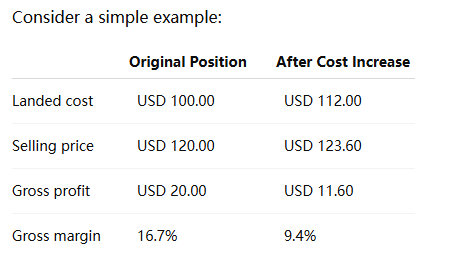
Here, landed cost rises by 12%, while selling price rises by only 3%. The business is still profitable, but the lubricant distributor margin falls by more than seven percentage points. Workshops, retailers and fleet customers may not accept a full increase immediately. Competitors may also be selling older, lower-cost stock, while exchange rates can move between quotation and customs clearance. The pressure appears in four areas.

- More Working Capital
- Slower Price Recovery
- Replacement Risk
- Greater Exposure in Synthetic Products
4 What Importers and Distributors Should Do Now
4.1 Review Margin by SKU
Do not judge profitability only by brand, container or total order value. Review each viscosity, specification and packaging size separately. Different viscosities and categories can have very different turnover rates. Good lubricant inventory planning for importers starts with knowing which products generate cash and which keep capital tied up. Focus first on products with repeat demand, faster turnover, broad channel relevance and packaging that matches local buying habits.
4.2 Protect Fast-Moving Grades
In many markets, the list should reflect local climate, vehicle age, fleet composition, fuel quality and workshop practices. A distributor should buy for the vehicles actually operating in the market, not simply for the widest possible catalogue.
4.3 Use Mixed-Product Loading Carefully
A mixed container lubricant supplier can help combine passenger car oils, diesel oils, motorcycle oils, transmission fluids, gear oils and hydraulic oils in one shipment. Used correctly, mixed loading can improve container utilization and reduce concentration risk. The order should still be built around proven demand, because too many low-volume SKUs create weak turnover and unnecessary complexity.
4.4 Build a 60–90 Day Replenishment Plan
Review inventory before fast-moving items are close to zero. Earlier planning gives buyers time to compare freight, confirm packaging and organize payment, reducing the risk of an urgent order with limited options.
4.5 Do Not Reduce Quality Without Understanding the Risk
A cheaper quotation can come from better sourcing and efficient production. It can also come from lower-grade base oil, reduced additive dosage or an unapproved formulation change.
Those choices are not equivalent. Short-term savings can lead to higher oil consumption, performance complaints, workshop claims and loss of distributor credibility. A sustainable factory-direct lubricant supply solution should control cost through planning, scale, packaging and logistics—not hidden quality reductions.

5 How TERZO Helps Distributors Improve Cost Control
Based on TERZO’s current procurement arrangements, production planning and available raw-material supply, the cost of selected products remains comparatively stable at the time of publication.
Prices cannot be guaranteed indefinitely; final quotations depend on formulation, packaging, quantity, freight and validity period. TERZO can, however, provide clearer cost visibility before an order is confirmed.
5.1 A Broad Product Range from One Supply Partner
TERZO supplies Passenger car engine oils / Heavy-duty diesel engine oils / Motorcycle oils / Transmission fluids / Gear oils / Hydraulic oils / Industrial lubricants / Antifreeze and other automotive fluids. Buyers can review the Centro prodotti lubrificanti TERZO, il passenger car engine oil range e il commercial vehicle engine oil range when planning an order. Working with one stable lubricant supplier can simplify communication, documentation and shipment planning.
TERZO does not need every buyer to order every product. A focused opening order is often more useful than a very wide catalogue, while existing distributors may need to protect fast-moving stock and reduce slow inventory. Our team can review the buyer’s destination market, vehicle structure, sales channels, packaging preferences and expected turnover before recommending a product mix.
5.2 Mixed Loading and Container Planning
The objective is to build an order around the customer’s market, rather than around the size of the factory catalogue.
Subject to production and loading requirements, different viscosities and product categories can be planned within one shipment.
For buyers seeking a reliable lubricant supplier for distributors, this offers a practical way to balance passenger car, commercial vehicle, motorcycle and industrial demand while controlling stock concentration.
Mixed loading may also help importers test additional categories without committing too much capital to a single product. However, TERZO will normally recommend keeping fast-moving products as the core of the shipment.
5.3 OEM and Local-Market Support
As an OEM lubricant manufacturer, TERZO can support qualified private-label projects with:
- Formulation selection
- Packaging planning
- Label development
- Multilingual adaptation
- Technical data sheets
- Export documentation
A workable OEM project should consider price, positioning, volume, compliance and repeat-purchase potential—not only label design. For some buyers, the TERZO brand may offer a faster route to market because product positioning and packaging are already established. For others with an existing distribution network, an OEM project may provide more control over local branding. The suitable model depends on the buyer’s sales channels, order volume and long-term market plan.
5.4 Cost Control Without Unapproved Downgrading
TERZO’s approach is based on procurement planning, standardized production, product selection and logistics coordination. Agreed materials and specifications should not be changed without customer approval.
A wholesale lubricant supplier with stable pricing should also provide stable quality. Low price without batch consistency does not protect a distributor’s margin in the long term.
A product complaint can cost more than the original saving once returns, customer compensation, workshop claims and damage to local reputation are considered.
For this reason, TERZO focuses on helping customers control the total purchasing cost, rather than simply offering the lowest possible invoice price.